Last week, as I approached the door of an estate sale in a double-wide at the back of a 55+ community, a woman stepped out, slammed the door behind her, hissed the word “Jesus!” and took a deep, steadying breath before blowing it out slowly through her mouth. As she stalked past me towards her car, she gravely counseled me: “If this is your first time, prepare yourself.”
Of course, I have never wanted to see the inside of a house more.
The rooms were stacked floor to ceiling with several lifetimes’ worth of goods. Glassware, watches, jewelry, clothing, and hundreds and hundreds of pairs of shoes.
One room contained what looked like 10 households’ worth of ancient tech with its blocky, sturdy aesthetic: walkmans, handheld radios, flip phones, and endless DVD players.
A dazzling find
From the bottom of a box stuffed with old phones, I picked out a Nokia E62. The seller gave it to me for $1 flat, and I walked out of there thinking that surely, doubtlessly this thing connects to wifi, and if it can connect to wifi, then anything is possible.
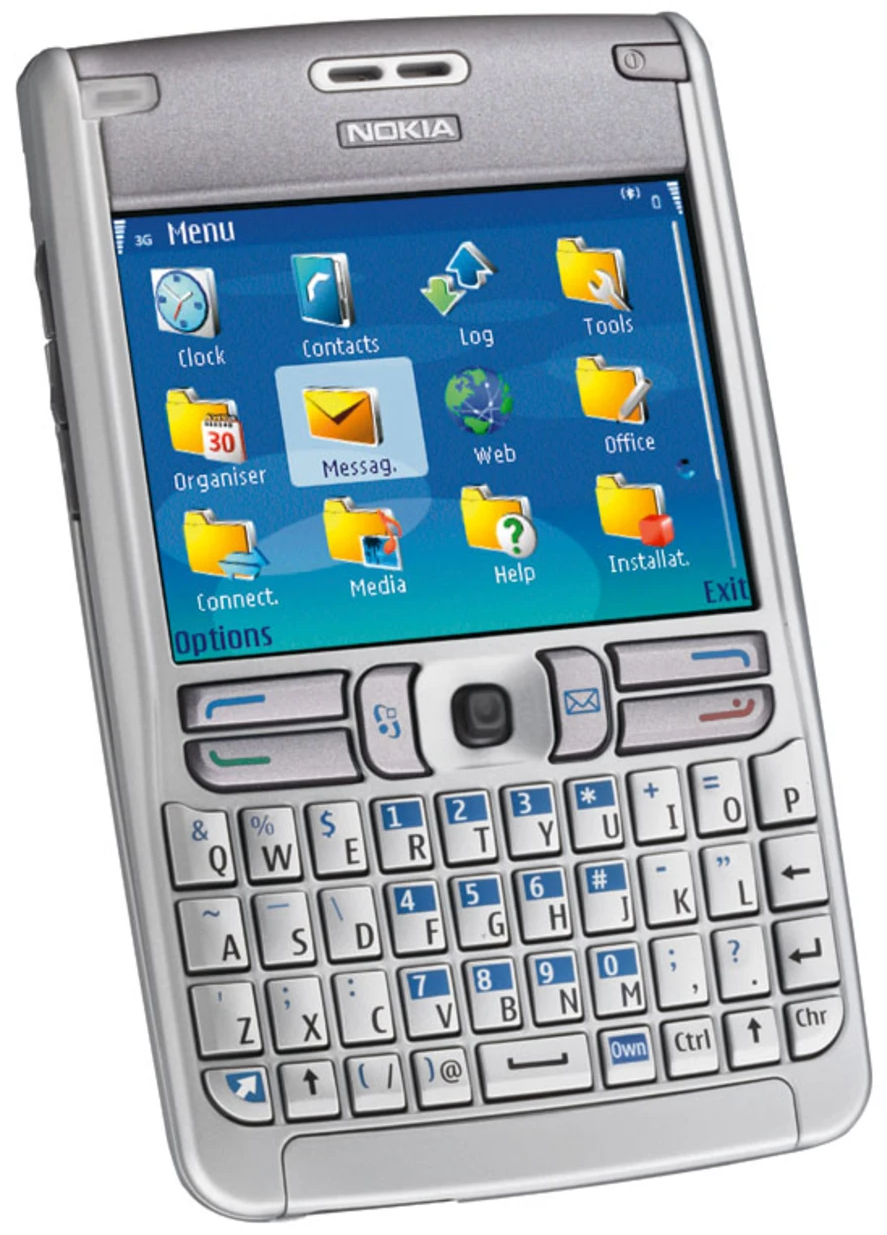
The tactile keyboard and especially the little gameboy-style joystick have an irresistible old-school charm.
Released in 2006, NBC News once called this phone “the best smartphone around.”
Imagine my disappointment upon reading that the E62 is in fact a “stripped down” version of the E61, which shipped with integrated wifi and 3G. In a baffling anti-pattern, the E62 shipped only with 2G, a long buried technology in the US.
But, the device is in great condition. It charges and boots up to the stock OS. I found a single logged call - to “Elaine” at 11:52pm on an August night in 2008.
You can see what NBC was talking about. The joystick feels satisfying to move, the OS contains just what you need, and you can even choose from among a whopping FOUR WHOLE THEMES. Although, let’s face it, the bowling game is f*cking hard! I imagine 14-year-old me spending an entire roadtrip in the backseat of the car trying to master it.
A philosophical reflection
What fascinates me about the E62’s blackberry-like design is its affordances.
Affordance: the property of an object that makes clear how it can or should be used
Setting it next to an iPhone, the difference is stark.
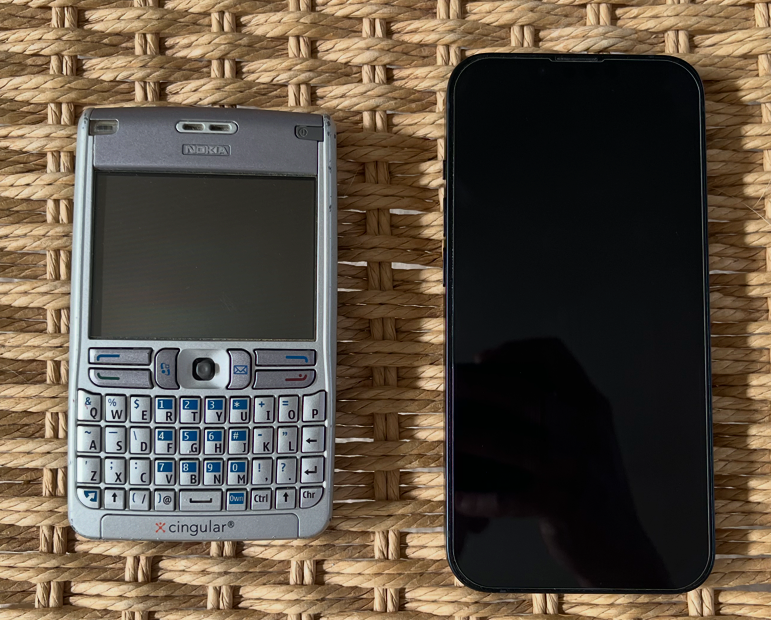
The E62 expects you to create, not consume. Nearly half of its surface is a dedicated input box. It’s a device created before the like button and it shows. In the era of “it was gr8 2 c u”, this keyboard was an indulgence. The designers knew you were going to gleefully text your friends in full sentences and type emails to your boss from Dunkin Donuts while they thought you were languishing in traffic. (You may be surprised to learn the E62 also accepted voice commands and had a dedicated voice input button on the side.)
Meanwhile, the iPhone is a black void that stares back, intended largely for consumption. It’s really the only logical design choice when you factor in the oft-cited 1% rule - that just 1% of users create the majority of content on sites like Reddit and Twitter. The other 99% merely “lurk”, a semi-derogatory online term for parasitically slurping up what others make while contributing nothing of your own. I’ve heard many of my colleagues refer to their phone as a “distraction rectangle”, a term widely attributed to ex-Googler and tech ethicist Tristan Harris.
In contrast to the E62, the iPhone is bright, colorful, lightning fast, and buttery smooth. Its form factor is much closer to that of a TV than that of a laptop. It reads like a toy, or perhaps an entertainment device. When you need to type something (if you need to), the keyboard pops up sheepishly, sometimes slowly; it’s one of the less polished iPhone features, in my opinion. It’s easy to make mistakes, the autocorrect isn’t very smart, it’s hard to type while looking away, and God help you if you need to type an asterisk or something. Priority is given to faster, easier interactions like tapping and swiping. Whatever burns the fewest calories. Whatever pumps up the like button and the repost counters the fastest.
The E62 reads as more of a tool, a vehicle for thinking. There’s no swiping, no tapping. Only navigating and writing. Its pixellated screen and laggy animations separate input from reward, those few hundred extra milliseconds making it exponentially less addictive. (An appalling yet hilarious “Bye.” also flashbangs you when powering it down.) The pain of navigating between screens makes the E62 more of a “focus rectangle”; if you’re going to use it, it had better be intentional. I doubt many people were picking up their E62 to check the time and getting sucked into a vortex of distraction.
Like many digital minimalists, I love its friction. I love its intentionality. I love that it wants you to create - to write instead of read, to speak instead of watch.
I was really hoping to get this thing to work.
A disappointing revelation
Of course, without wifi, I knew it was a pipe dream.
I mean, the OS definitely has to go. It’s insanely outdated, clunky, and probably insecure.
Blithely hoping to repurpose the screen and keyboard to use with a Raspberry Pi (or for some project that preserves the phone’s form factor), I did a complete teardown of the E62, which oddly enough was archived step-by-step in 2019 by mysterious hobbyist Jose Gustavo Abreu Murta.
I concluded that, although a raspberry pi zero would probably fit inside the device, it would need a new battery, and after chatting with Claude I came to the conclusion that the proprietary display drivers would need to be reverse engineered, and the keyboard keys would need manual remapping or something, and the joystick might never work with another OS. This project was way over my skill level.
So, this thing is basically just e-waste, a fact my wife casually informed me she knew from the beginning. It wasn’t spiteful! She’s a designer. I saw it more so as a reminder that once a technology is gone, it’s gone. The E62 launched to positive reviews at a time when tech was a tool, not an addiction. These days, it’s as much as any of us can do to keep our noses out of our “distraction rectangles” and in the real world.